
Why the change?
The new three-tier system
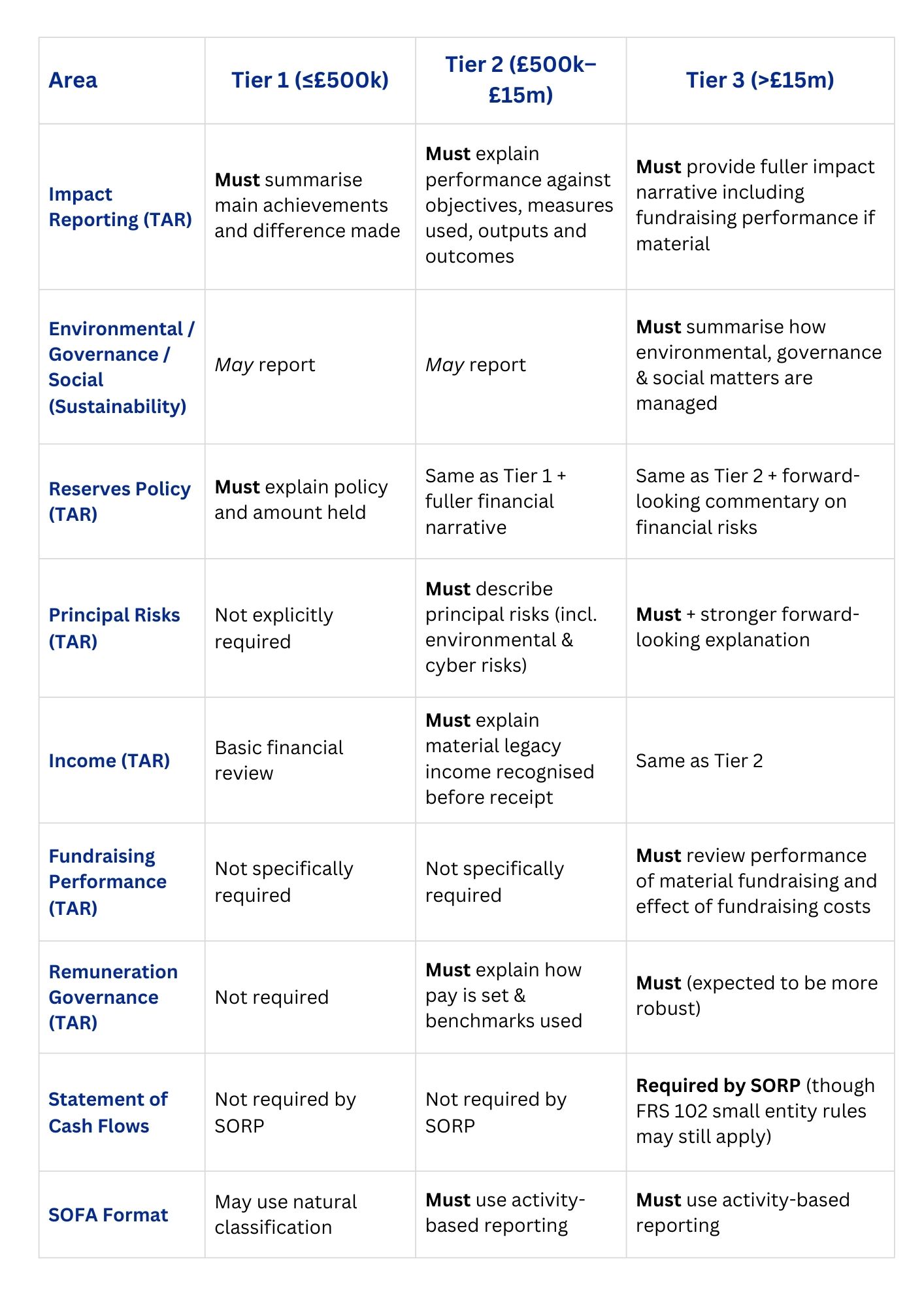
Simpler requirements designed for small charities. You’ll still prepare accruals accounts, but the disclosures are lighter than the higher tiers.
The “standard” SORP requirements — similar to what most charities follow now.
Extra disclosures for the largest charities to give greater transparency about their activities, impact and governance.
SORP 2026 – Tier Differences at a Glance
Other key changes in SORP 2026
• Income recognition
There is updated guidance on when income should be recognised, particularly for grants and contracts. The rules now more clearly distinguish between exchange transactions (such as service contracts) and non-exchange income (such as donations and grants), and when performance conditions delay recognition. If your charity receives significant grant or contract income, it’s worth reviewing this carefully.
There are significant changes to how leases are accounted for. In some cases, charities will now need to recognise a “right-of-use” asset and a corresponding lease liability in their accounts. This is particularly important if you rent property, lease equipment, or have a long-term or peppercorn lease arrangement.
The section on the annual report has been refreshed. There’s more emphasis on clearly explaining your reserves policy, plans for the future, and the difference your charity is making. Larger charities also have additional expectations around risk and sustainability reporting.
Reporting has been simplified and terminology aligned more closely with the Charities Act 2011, making this area clearer for charities that make mission-related investments.
The guidance has been reorganised and clarified, helping charities better understand what should (and should not) be recognised as a provision or disclosed as a contingent liability.
Does this affect my charity?
If your charity or church prepares receipts and payments accounts, this change won’t affect you right away — those charities don’t follow the SORP.
But if you prepare accruals accounts (that is, accounts that include things like assets, debtors, and creditors), then you will need to follow SORP 2026 for accounting years that start on or after 1 January 2026.
For example:
- If your year-end is 31 December, your first SORP 2026 accounts will be for the year ending 31 December 2026.
- If your year-end is 31 March, your first SORP 2026 accounts will be for the year ending 31 March 2027.
Final thoughts
SORP 2026 isn’t about making life harder — it’s about making charity reporting clearer, more consistent, and fairer for organisations of all sizes.
For most small churches and charities, the new Tier 1 system should make things simpler, not more complicated. But it’s still worth taking time to understand what’s changing and talk it through with your independent examiner or accountant.
And remember: if your charity is a limited company, you’ll still need to prepare full accruals accounts under the SORP, whatever your income level.
The new SORP applies from January 2026, so this year and next are the perfect time to get ready.
Need Further Support?
If you would like help understanding how SORP 2026 applies to your church or charity — or if you’d simply like to talk things through before your next year end — please get in touch with Wyatt & Co Chartered Accountants.
You can contact us at office@wyattandco.net
, and a member of our team will be happy to assist.